Playbook 02 Product Data & Know-How · 8 min read · Maison Heritage · Merchandising · Product Development
Turning Your Technical Sheets into Living Authentication Checklists
How a maison’s product specs and expert know-how become a repeatable, point-by-point inspection grid for every season.

01 · Ground truth already exists in-house
Your technical sheets hold the exact details counterfeiters miss
Counterfeiters copy what they can see from a storefront window or a product page photo. What they rarely get right—and what changes from season to season—lives inside your technical files: the exact thread gauge on a saddle stitch, the supplier mark on the underside of a zipper slider, the kerning on a woven care label for a specific factory run.
As the 2025 OECD/EUIPO global study notes, counterfeit networks increasingly rely on 'localization'—shipping generic garments and attaching counterfeit labels, hardware, and trims in regional workshops [1]. Meanwhile, public marketplace enforcement data from Vestiaire Collective shows counterfeit rejections rose by +50% compared to 2021 as 'superfakes' mastered overall silhouettes [2]. Until now, the micro-knowledge required to spot them stayed locked in PDF spec sheets or in the heads of two senior merchandisers.
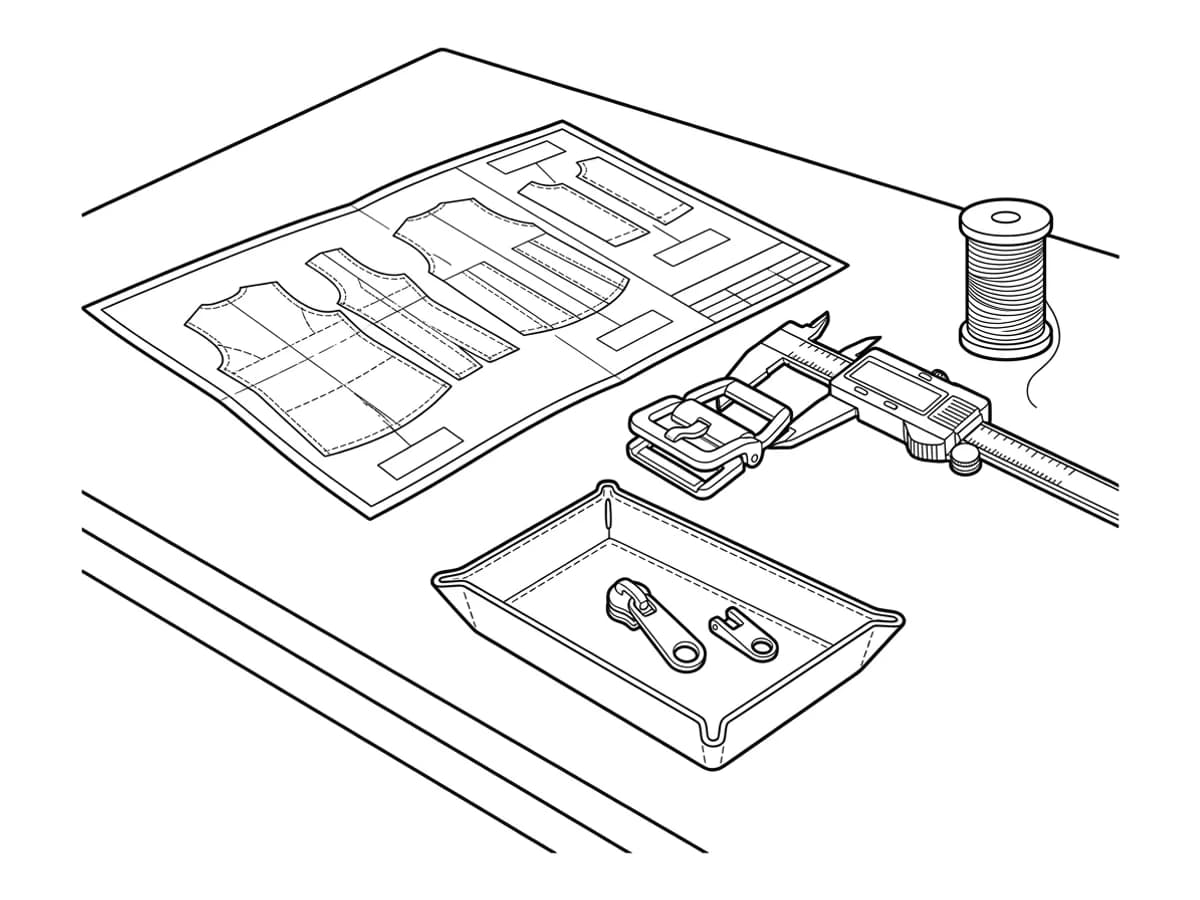
- Bill of materials (BOM) → Hardware & trim pointsZipper pull engravings, snap-button backs, buckle finishes, and D-ring welds become Key (×3) checkpoints requiring a macro photo.
- Labelling specs → Typography & code pointsMain label weave, care label composition layout, season format, and factory code rules become Key (×3) checkpoints.
- Construction notes → Seam & stitch pointsStitch density per centimetre, bar-tack placement, and edge paint finish become Major (×2) or Minor (×1) checkpoints.
02 · Weighting every point
Why Key (×3), Major (×2), and Minor (×1) weights matter
Not all details carry the same diagnostic value. A slightly worn outsole on a second-hand sneaker is normal wear; a wrong font on the inner size tag is a counterfeit. In LegitV, every point on a model checklist is assigned one of three weights: Key (×3), Major (×2), or Minor (×1).
A single red flag on a Key point is enough to call a fake, regardless of how clean the silhouette looks. And when a senior authenticator spots a new counterfeit batch in the field, that feedback updates the checklist for every store and warehouse immediately.
59 model checklists are live today (from 5 to 34 points each). For your own brand, we start with a pilot on two or three models built from your sheets with your experts.
OPERATIONAL COMPARISON
From static PDF spec sheet to live LegitV checklist
| Spec sheet section | Traditional use | In a LegitV checklist |
|---|---|---|
| Cover & reference codes | Archived after production | Validates season, colourway, and factory code format |
| Bill of materials (BOM) | Used by sourcing & costing | Key (×3) checks on hardware engravings and trims |
| Labelling & care instructions | Checked once at pre-production | Key (×3) checks on font kerning, weave, and ® mark |
| Construction & stitch density | Factory QC tolerances | Major (×2) checks on signature seams and finishes |
FREQUENTLY ASKED QUESTIONS
Operational questions on spec sheet to checklist
Do we need to integrate our ERP or PLM before starting?
No. We build the first checklists directly from your technical sheets and reference photos with your experts. A pilot on two or three models requires zero IT integration.
How many points does a model checklist have?
Between 5 and 34 points depending on the complexity of the piece—for example, 6 points on a Levi’s 501, 23 points on a Nike Dunk, and up to 34 points on complex leather goods and outerwear.
BIBLIOGRAPHY · PRIMARY STUDIES & REFERENCES
Research papers, regulations and industry benchmarks
- [1]Mapping Global Trade in Fakes 2025: Localization of Unassembled Labels and Hardware
OECD & EUIPO (2025) · OECD Publishing, Paris · Primary source ↗
Highlights how counterfeiters assemble generic bases with separately imported counterfeit labels, zippers, and hardware, making BOM-level component checks decisive.
- [2]Circularity & Trust Report / Luxury Goods Worldwide Market Study
Vestiaire Collective & Bain & Company / Altagamma (2024–2025) · Public Marketplace Enforcement Data · Primary source ↗
Documents a +50% rise in counterfeit-related listing rejections vs. 2021 as high-grade replicas copy overall silhouettes and only fail on micro-construction and season-specific labelling.