Playbook 01 Returns & Reverse Logistics · 7 min read · Retail Ops · E-Commerce · Returns Warehouses
Stopping Counterfeit Return Fraud and Wardrobing Before the Refund Clears
How luxury houses, multi-brand retailers, and e-commerce warehouses stop replica swaps at the returns desk in under two minutes.

01 · The blind spot in reverse logistics
Why barcode and hangtag scans miss replica swaps
Across US and European retail, merchandise returns represent $685B to $890B in annual volume, and roughly 15% of those returns ($76B to $103B) involve return fraud or abuse [1]. In high-margin apparel, footwear, and leather goods—which together account for 62% of all counterfeit customs seizures worldwide [2]—the most damaging scheme is the replica swap: a buyer orders an authentic piece online, transfers the genuine swing tag or packaging onto a superfake purchased via small-parcel cross-border channels, and sends the replica back for an automatic refund.
At a busy warehouse or boutique desk, associates have ninety seconds to process a parcel. They check that the SKU matches the packing slip, glance for obvious stains, scan the barcode, and trigger the refund. Worse, the unspotted fake goes straight back into active inventory and ships to the next full-price customer.
- The tag-transfer blind spotPlastic loops, RFID stickers, and cardboard swing tags are trivial to detach and re-attach. Only the physical construction of the piece proves it is the item that left your warehouse.
- The speed vs. expertise trapSending every returned bag or sneaker to a central authentication hub adds days of delay and €15–€50 per piece in handling. Store and warehouse staff need a guided pre-check that runs at the desk.
02 · Desk workflow
A guided 4-photo check before the refund is released
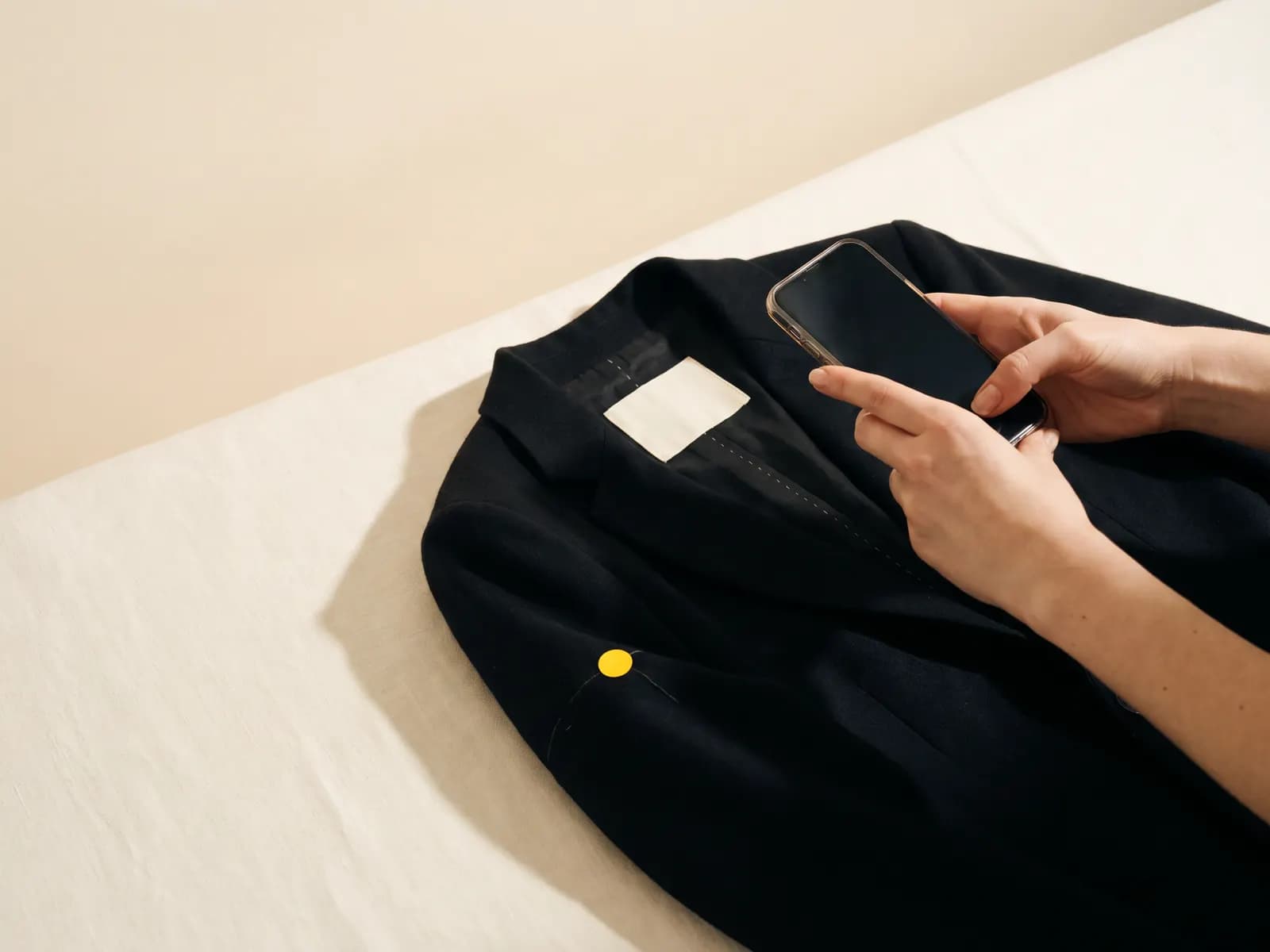
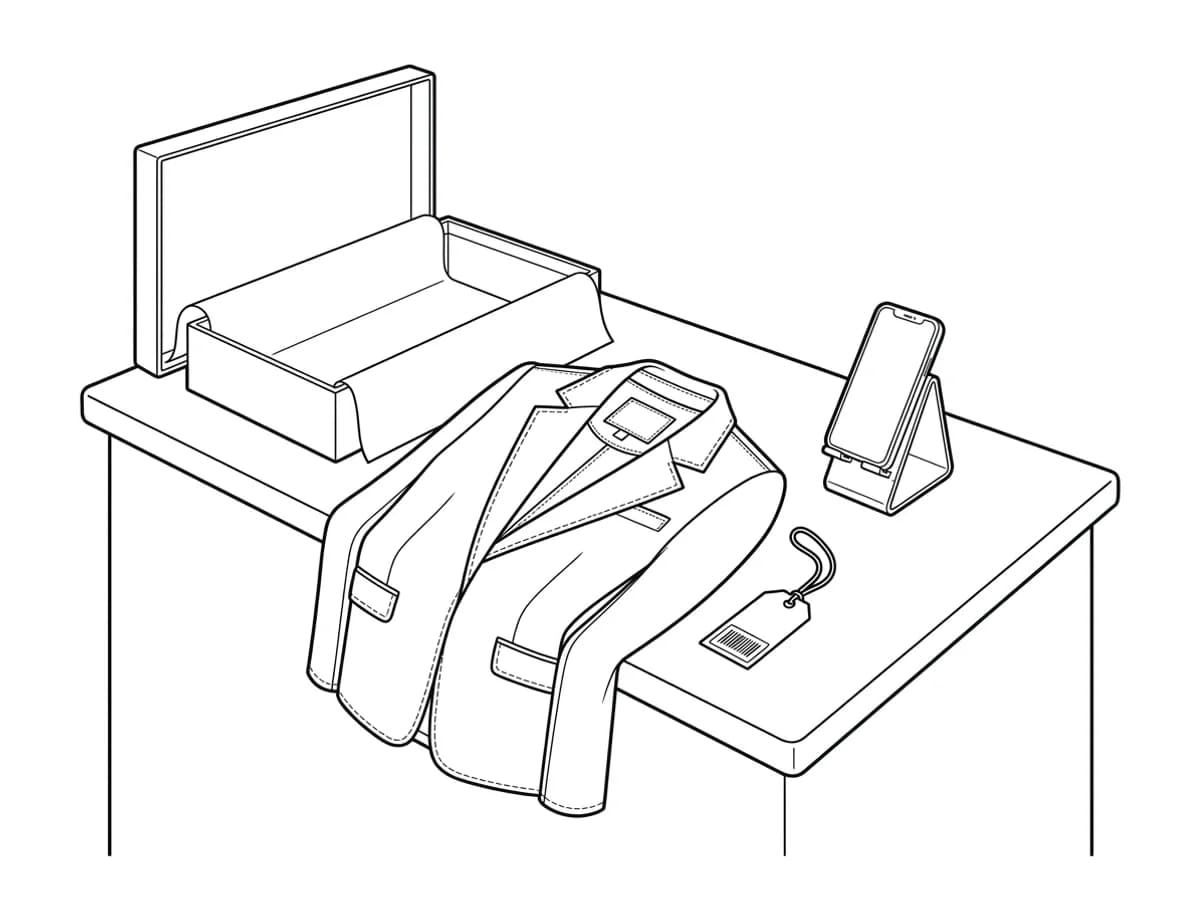
LegitV turns your model checklist into a guided capture flow on any phone or tablet, with nothing to install. When a return arrives, the operator selects the reference and shoots the exact details the app asks for: main woven label, size/care tag, hardware engraving, and signature seam.
Within seconds (~15s via API or under two minutes including photo capture), each point comes back as Match, Not seen, or Red flag. Clear items clear into A-grade restock immediately. Any red flag on a key point puts the refund on hold and packages the cropped evidence for your after-sales or loss-prevention team.
If a key point raises a red flag, the refund is held before payout—with point-by-point photo evidence attached to the return ticket.
03 · Triage thresholds
You set the line between automatic restock and expert review
Not every return needs the same threshold. A €180 denim jacket and a €2,800 leather shoulder bag carry different risk profiles. With LegitV, your operations team sets the two decision lines: above the accept line, the return clears into stock; below the hold line, it is quarantined; in between, your internal expert gets the full point-by-point file and decides in 30 seconds instead of 15 minutes.
Crucially, if a photo taken at the desk is too blurry to read a serial stamp, LegitV never guesses. It marks the point Not seen and asks the operator to retake that single angle on the spot.
OPERATIONAL COMPARISON
How returns teams handle high-risk SKUs
| Dimension | Visual glance + barcode scan | LegitV point-by-point check |
|---|---|---|
| Time at the desk | 60–90 sec (packaging & hangtag only) | Under 2 min (4–6 guided model photos) |
| Replica with swapped hangtag | Usually accepted into A-stock | Caught on label weave, font, or hardware |
| Blurry or missing angle | Ignored under queue pressure | Marked Not seen; asks for a retake |
| Dispute documentation | Word of the warehouse vs. customer | Shareable report with every point explained |
FREQUENTLY ASKED QUESTIONS
Operational questions on returns & wardrobing control
Does a returns check require special cameras or microscopes?
No. Standard smartphones or tablets in the warehouse or store are enough. The web app guides the operator on which close-up angles to shoot for that specific model.
What happens if an item is genuine but worn or damaged?
A worn stamp or missing tag is marked Not seen rather than failed. Your team sees both the authenticity points that matched and the missing or worn elements before choosing restock, refurbishment, or rejection.
BIBLIOGRAPHY · PRIMARY STUDIES & REFERENCES
Research papers, regulations and industry benchmarks
- [1]Consumer Returns in the Retail Industry
National Retail Federation (NRF) & Appriss Retail (2024–2025) · NRF Benchmark Report · Primary source ↗
Documents $685B–$890B in annual US retail returns, with $76B–$103B (~15%) lost to return fraud and abuse; ~60% of retailers report wardrobing and counterfeit/decoy swap returns.
- [2]Mapping Global Trade in Fakes 2025: Global Trends and Enforcement Challenges
OECD & European Union Intellectual Property Office (EUIPO) (2025) · OECD Publishing, Paris · Primary source ↗
Establishes that global counterfeit trade reaches $467B (€99B in EU imports), with clothing, footwear, and leather goods representing 62% of all seizures and 79% of interceptions shipped in small parcels (<10 items).