Playbook 04 Stock Intake & Quality Control · 7 min read · Logistics · Buying Teams · Quality Control
Checking Incoming Stock and Pre-Shipment Lots Against Model Checklists
How buying teams, consignment warehouses, and production controllers check every piece at the door with a phone or tablet.
01 · The receiving bottleneck
Why paper binders and memory fail at the intake table
In second-hand buying, consignment intake, and multi-workshop apparel production, operators inspect dozens of different references a day. Relying on memory or static PDF guides means one operator checks the care label font while the next only checks the exterior logo.
In industrial quality control, ISO 2859-1 (ANSI/ASQ Z1.4) Acceptance Quality Limit (AQL) sampling [1] was designed to spot recurring sewing defects across homogeneous factory runs. It was never designed to catch unit-level counterfeit swaps in B2B wholesale lots or late-stage trim substitutions across subcontracted tiers [2]. When a batch of 200 pieces lands on the receiving dock, you need a fast, standardized check that tells the operator which 4 or 5 photos to take for that exact reference.
- Consignment & buy-back intakeVerify every parcel at the warehouse table before booking the item into inventory or releasing seller payout.
- Wholesale & parallel-channel auditsSpot mixed batches where a handful of replicas are slipped inside a lot of genuine pieces.
- Production & trim conformityConfirm that main labels, care tags, hardware engravings, and stitch density match the approved reference sheet.
02 · Standardized capture
Same checklist at every table, in every warehouse
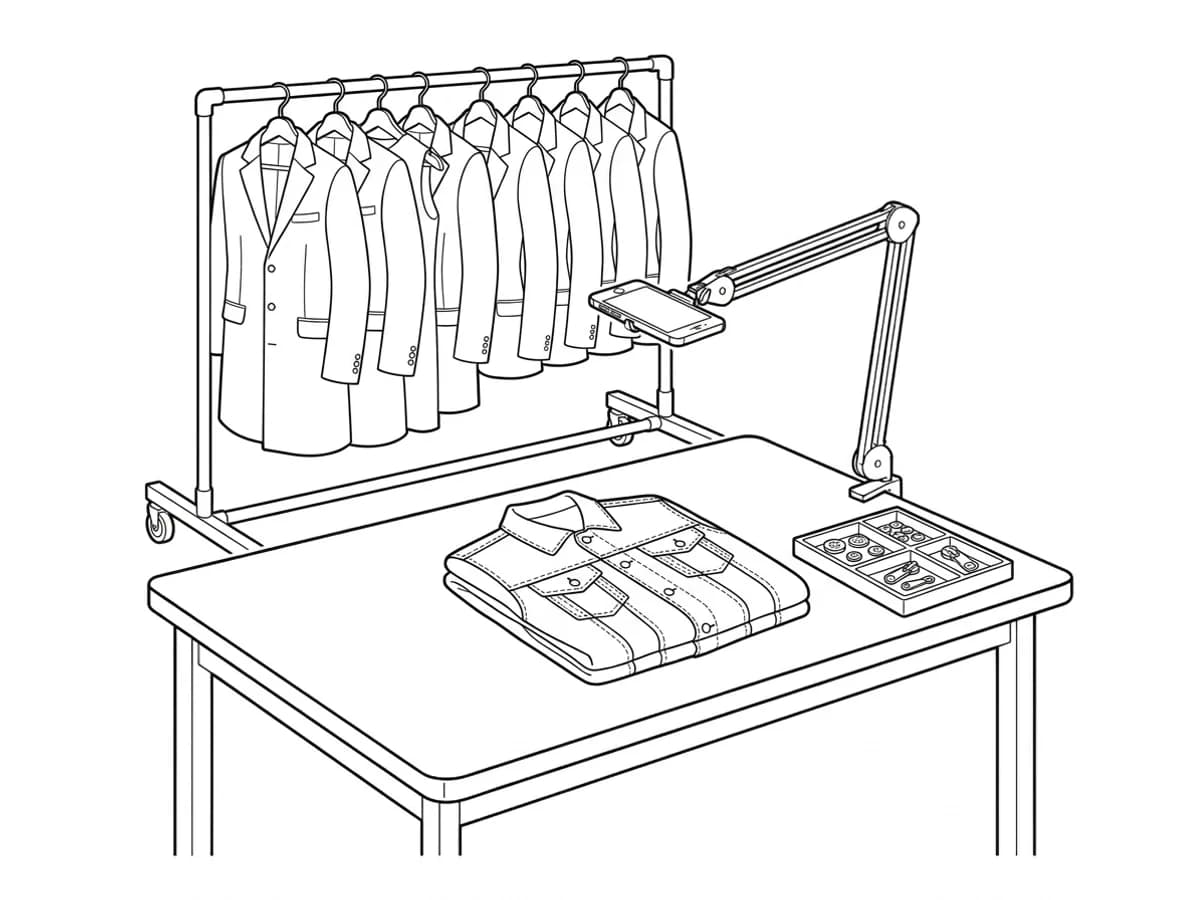
With LegitV, the receiving operator opens the web app on a phone or a tablet, selects the reference, and follows the photo prompts. The checklist specifies the exact zones to shoot—for instance, the copper rivet stamping, arcuate stitch, red tab font, and leather patch on a pair of denim jeans.
The verdict returns in minutes, and every item gets a timestamped report showing which points matched, which were not seen, and which raised a red flag.
Clear items move straight to shelving and photography; flagged items are set aside with their point-by-point report ready for the head buyer.
OPERATIONAL COMPARISON
Ad-hoc intake vs. checklist-driven intake
| Step | Ad-hoc visual intake | LegitV intake workflow |
|---|---|---|
| What gets checked | Depends on which operator is on shift | Fixed 5–34 point checklist per model |
| Photo archive | Raw folder of unlabelled phone photos | Cropped photos tied to each named point |
| Escalation to senior buyer | Item carried across the warehouse | Link to the report with red flags highlighted |
| Onboarding new staff | Weeks of shadowing a senior authenticator | Guided photo prompts from day one |
FREQUENTLY ASKED QUESTIONS
Operational questions on stock intake & qc
Can we use LegitV on a phone mounted over a packing table?
Yes. Because LegitV runs in a standard web browser on any phone or tablet, teams use it both handheld in stores and on overhead stands at warehouse intake tables.
Can we send intake photos through our own warehouse software?
Yes. If your warehouse already captures photos during receiving, your system can send them to the LegitV API and get the verdict and point-by-point breakdown back as JSON.
BIBLIOGRAPHY · PRIMARY STUDIES & REFERENCES
Research papers, regulations and industry benchmarks
- [1]ISO 2859-1 — Sampling Procedures for Inspection by Attributes (AQL)
International Organization for Standardization (ISO) (1999 / 2023) · ISO Standard · Primary source ↗
Defines statistical lot sampling by attributes (Critical / Major / Minor defects), which measures batch defect rates but cannot guarantee unit-level authenticity on high-value or mixed-origin stock.
- [2]Mapping Global Trade in Fakes 2025: Supply Chain Dispersion in Apparel & Footwear
OECD & EUIPO (2025) · OECD Publishing, Paris · Primary source ↗
Shows how counterfeit apparel and footwear supply chains disperse across regional hubs and micro-workshops, increasing trim and label infiltration risks.