Playbook 07 Vintage & Archive · Denim Forensics · 8 min read · Vintage Collectors · Denim Buyers · Thrift & Archive Curators
Vintage Levi’s 501 & Archive Denim: Button Stamps, Red Tabs, Care Tags, and Era Contradictions
How to tell a genuine Valencia Street (`555`) or pre-1971 Big E 501 from a Thai fake or modern reproduction by cross-checking chronological construction markers.

01 · The #1 fake tell in vintage denim
Why era contradiction catches fakes that copy every part individually
High-priced vintage Levi’s 501s—from pre-1971 'Big E' pairs to 1970s '66 Single Stitch' and 1980s–2002 US-made Valencia Street (`555`) pairs—are among the most heavily counterfeited garments on second-hand marketplaces. Counterfeiters in Southeast Asia and reproduction workshops buy vintage shuttle-loom denim, stamp buttons with desirable codes, and distress the fabric with potassium permanganate and pumice.
What counterfeiters almost always get wrong is the timeline. Every factory code, rivet metal, pocket bar-tack, red tab weave, and care tag existed during a specific window of years [1]. When a checklist cross-checks those points together instead of scoring them in isolation, an impossible combination triggers an immediate Key-point veto.
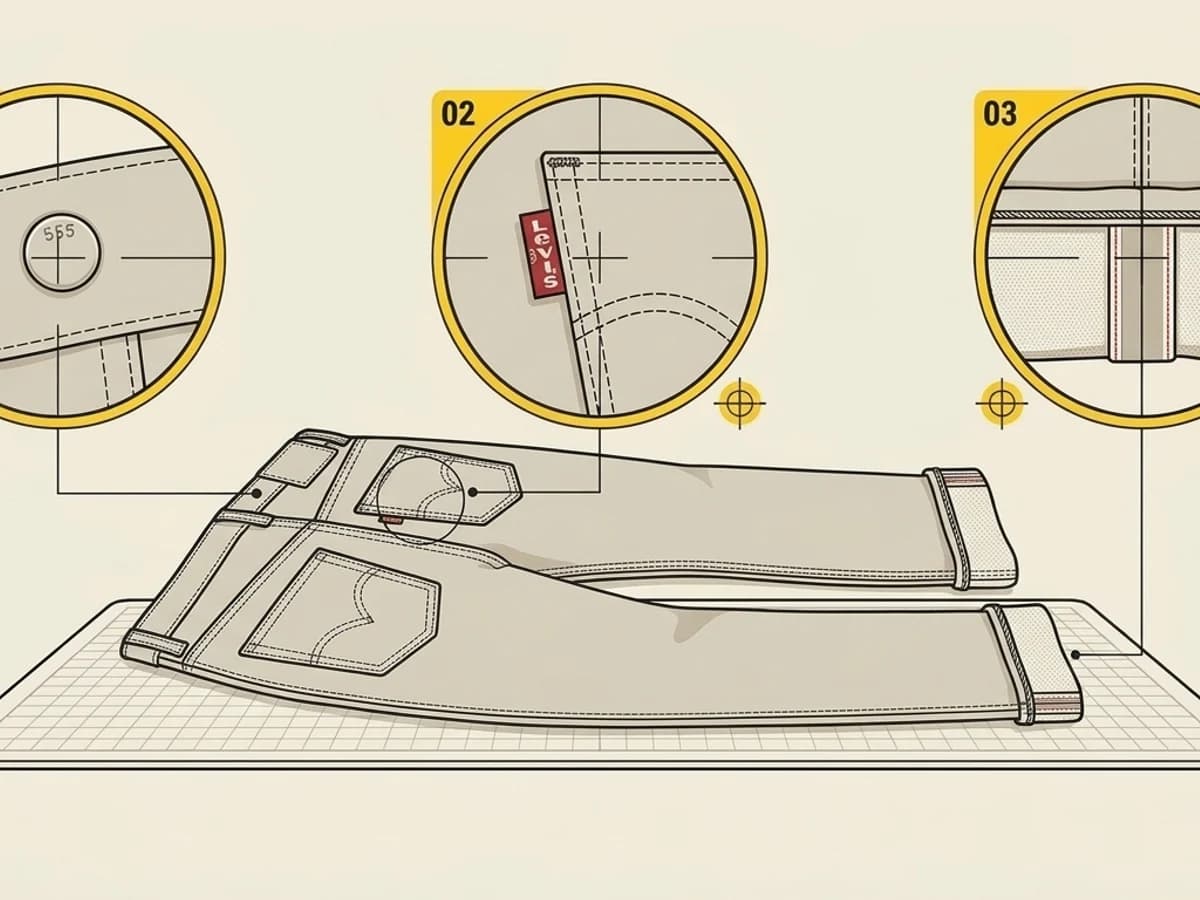
- The Big E transition (1971)Levi’s switched the red pocket tab from capital 'LEVI’S' (Big E) to 'Levi’s' (small e) in 1971 [1]. An original pre-1971 Big E pair never carries a modern multi-page satin care tag; if it has both a Big E tab and a 1990s/2000s care tag, it is either an official Levi’s Vintage Clothing (LVC) reproduction—which must match LVC tag formatting—or a counterfeit.
- Redline selvedge vs. overlock outseams (~1983–1986)Original US 501 production transitioned from narrow Cone Mills shuttle-loom redline selvedge to wide-loom overlocked outseams between 1983 and 1986. The internal pocket bag print and care-tag format must match that transition window.
- Button-back factory stamps (`555`, `524`, `6` vs. `501`, `3496`)Authentic US factory codes are stamped into the back of the top fly button (`555` Valencia St., `524` El Paso, `501` is NEVER a genuine US factory code on the back of a vintage button—it is the classic tell of a counterfeit button die) [2].
02 · Hem stitch & patina tolerance
Chainstitch roping (ISO 401) and how LegitV handles honest wear
On vintage 501s and selvedge denim, the bottom hem and waistband construction reveal whether a pair is original, altered, or replicated. Vintage Union Special 43200G machines sew a two-thread chainstitch (ISO 4915 class 401) whose diagonal tension pulls the folded denim into distinct diagonal ridges ('roping') after washing [3]. Cheap reproductions and post-purchase alterations use a flat single-needle lockstitch (ISO 301) that never ropes.
At the same time, a 40-year-old pair of jeans will naturally have a cracked Two Horse Jacron patch or a washed-out care tag. A rigid system that fails unreadable tags rejects genuine vintage. LegitV marks faded or missing tags as Not seen and computes the verdict and estimated era from the surviving hardware, weave, and stitch points.
When you check a covered Levi’s 501 reference on LegitV, the report doesn’t just say match or red flag—it cross-checks the button stamp, tab, outseam, and tag to report the estimated production era (e.g., 1966–1971 Big E, 1973–1977 66 Single, or 1996 Valencia St. LVC).
OPERATIONAL COMPARISON
Key chronological markers on vintage Levi’s 501 checklists
| Checkpoint | Authentic Archive Specification | Common Counterfeit / Repro Mismatch |
|---|---|---|
| Top button back stamp | Plant code matching era (`6`, `E`, `524`, `555` Valencia 1980s–2002) | Blacklisted stamp (`501`, `3496`) or `555` claimed as an original 1960s pair |
| Back pocket Red Tab | Big E (`LEVI’S`) up to ~1971; small e (`Levi’s`) from 1971 onward (except LVC) | Big E tab sewn onto a 1990s stonewashed non-LVC body |
| Back pocket top corners | Hidden copper rivets (pre-1966) → exposed black/thread bar-tacks (post-1966) | Hidden rivets paired with a 1980s care tag without LVC markings |
| Inseam & hem stitching | Two-thread chainstitch (ISO 401) with diagonal roping on original hem | Flat polyester lockstitch (ISO 301) with artificial sandpaper abrasion |
FREQUENTLY ASKED QUESTIONS
Operational questions on vintage levi’s 501 & denim guide
Does a `555` button stamp mean my Levi’s 501 is fake?
No—`555` is the genuine code for Levi’s historic Valencia Street factory in San Francisco (closed in 2002), which produced both regular US 501s and official Levi’s Vintage Clothing (LVC) reproductions. However, because `555` commands high collector prices, it is also the most copied stamp on Thai and Chinese fakes. LegitV checks the typography of the `555` stamping and verifies that the care tag and selvedge match Valencia Street production.
What if the paper patch or inside care tag is completely washed out?
LegitV marks the washed-out tag as Not seen, never as a red flag. The verdict relies on the visible hardware (button stamp, rivet burrs), the red tab weave, the arcuate stitch geometry, and the outseam construction.
BIBLIOGRAPHY · PRIMARY STUDIES & REFERENCES
Research papers, regulations and industry benchmarks
- [1]Archival Guide to Dating 501® Jeans: Tabs, Rivets, Care Tags, and US Factory Codes
Levi Strauss & Co. Archives (Downey, L.) (2014–2024) · Levi Strauss & Co. Historian & Archive Documentation · Primary source ↗
Documents the historical timeline of 501 construction changes, including the 1966 hidden-rivet removal, the 1971 Big E to small e transition, care tag introduction, and Valencia Street (555) production.
- [2]Button-Back Die Forensics and Chronological Contradictions in Counterfeit Vintage Denim
Denim Forensics & Collector Compendium (2025) · Archival Apparel Authentication Notes · Primary source ↗
Catalogues counterfeit button-back dies (including '501' and '3496') and demonstrates how era mismatches between button stamps, selvedge IDs, and care tags expose high-grade reproductions.
- [3]ISO 4915: Textiles — Stitch Types — Classification and Terminology (Class 300 Lockstitch vs. Class 400 Chainstitch)
International Organization for Standardization (ISO) (1991–2024) · ISO Technical Standard · Primary source ↗
Defines the mechanical loop geometry of Class 401 two-thread chainstitching responsible for diagonal hem roping on vintage shuttle-loom denim.